
 “Ornithological taxi-chrono-polymy.”
Henry stared blankly at Charles. “You lost me somewhere around the taxi,” he admitted.
Charles grinned. “So you understood the ornithological part?”
“Yes – birds, and I can SEE they are birds of various kinds. Nicely mounted, too. I like the glass cases. Kindly explain the rest of the title.”
“Taxi- means to organise or put in order,” Charles responded. “You are familiar with taxidermy, no doubt?”
“Obviously – stuffed animals and such,” huffed Henry.

“So taxidermy is, etymologically speaking, the art of organising a deceased creature’s skin (that’s the dermy part) to make it look lifelike by – yes – stuffing it carefully, adding glass eyes and whatnot. Well I haven’t used the skins of dead birds for my process. I’ve used watch parts, which is the chrono, and a substance known as polymer clay, which you brought back from one of your time-travel excursions to the twentieth century. I decided polymy would be a suitable term for that. Simple really.”
“Hmm, if you happen to have eaten a dictionary,” observed Henry. “It doesn’t exactly slip off the tongue, though, does it? Surely you need a simpler name if you’re planning to market these handsome creatures. Steam Birds, for instance.”
“STEAM birds?” spluttered Charles. “Where the devil is the logic in that? They don’t relate to steam in any way. They merely sit in their cases and look decorative.”
 Henry paused for a moment, looking pensive. Then a large smile crossed his face.
“Yes,” he said, firmly. “It stands for Small Technical Experimental Avian Models. Avian refers to birds, Charles, as I’m sure you know.”
Charles regarded him for a moment, then erupted into peals of laughter.
“Touché, old chap! Most ingenious! Very well, then – STEAM Birds they will be.”
 If you are planning to visit any of our forthcoming Steampunk-Shrunk sales (see home page for details) in the next few months, you will be able to see and perhaps buy one of Charles’ ingenious little birds, such as the Crested Red-backed Cogfinch shown here.
 George Entwhistle, a patents clerk by day, had always enjoyed tinkering. The trouble was, tinkering could be a somewhat noisy activity. Living as he did in a terraced property, he had to contend with frequent complaints from neighbours and visits from members of the constabulary.
 Imagine George’s surprise and delight as he discovered a further door at the base, which opened quite easily, revealing a large cellar!
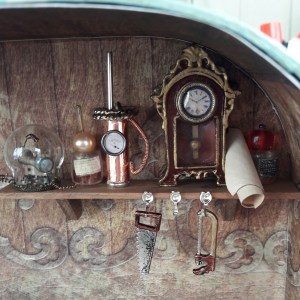
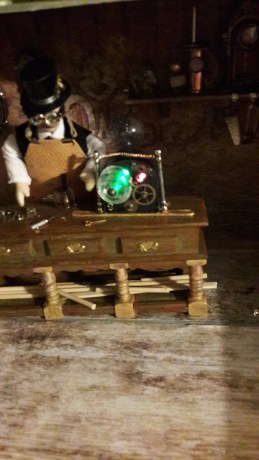 From that day onward, George worked to transform the cellar into a tinker’s workshop. He extended the heating pipes downwards to power a boiler, which not only heated the workshop, but allowed him to brew a much-needed cup of tea from time to time. He constructed a doorbell with a wire connecting it to the front of his house, so that callers could be heard. He made himself a shelf and workbench and even installed a clock and mirror. The result was a commodious and most agreeable work space. George was a happy man.
 As you can see, his contraption is well underway, and he’s able to fire it up for short periods.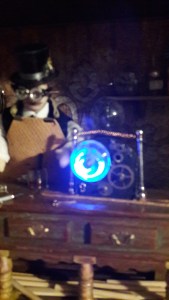

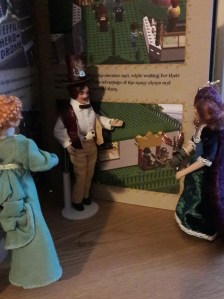 “Good lord!” Barnaby Balsover exclaimed, “There’s a chap there having his shoes polished by a clockwork automaton! Quite remarkable!”
 Steampunk - Shrunk!