
 I, Ebenezer Crackington, am by trade a clockmaker. I have worked at this trade since I completed my apprenticeship in the beautiful city of Paris, France, many years ago, at the age of twenty-two.
For eighteen years I made a reasonable living producing table and mantle clocks of the finest quality, encased in glass domes so that the mechanism could be viewed by the owners.
One memorable day, however, my shop was visited by none other than Lord Horatio Backgammon.
Imagine my amazement as this great gentleman entered the door and removed his hat, just as any lesser person might do.
I bowed to his lordship and offered him a chair, wishing that I had some upholstered seating, rather than the plain wooden variety.
Nevertheless, his lordship deigned to sit upon this humble piece of furniture with no complaint and addressed me in the following manner:
“Crackington,” he said, “You have been recommended to me by certain gentlemen at my club as being a first rate craftsman. Would you say they are correct?”
No doubt my face reddened rather at this most unexpected compliment, but I kept my head and replied, “Why I certainly believe it to be the case, Your Lordship, judging by the testimonials I have received from satisfied customers.”
“Good show,” Lord Backgammon responded. “In that case, I have a most particular commission for you.”
I promptly availed myself of a pen and my order book, hoping that my exterior appearance remained calm, despite my inner excitement.
Lord Horatio Backgammon informed me that, for reasons he was unable to disclose, he needed to wake and rise at a various times during the night in order to attend meetings of an extremely significant nature. His prompt arrival at these rendezvous was of the utmost importance.
Unfortunately, his lordship was a very heavy sleeper and was having great difficulty waking on time.
He asked whether I had any experience in constructing adjustable mechanical alarm clocks. I assured him that I had served as apprentice under M. Antoine Redier, the inventor and patent holder of such devices.
“Well they are useless!” his lordship informed me. “I require a device at least ten times louder than such paltry machines and one which involves a further element of surprise. Can you do it?”
I assured him that I could, and would start work on it that very day.
Lord Backgammon left his card and a generous down payment and departed.
 I commenced by using a double bell for the alarm mechanism, with a strong beater which alternated between the two. I then constructed a large claxon, which I fashioned from a trombone horn, which moved about in a haphazard and suitably alarming fashion when activated.
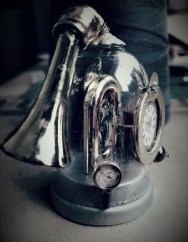 Since I was concerned that the ensuing noise might perforate his lordship’s eardrums, I installed a decibel gauge, which would shut down the alarm if dangerous sound levels were reached.
Lord Backgammon was delighted with his device and pronounced it satisfactory in every respect.
Thus I find myself the inventor of the Ebenezer Crackington Alarming Clock.
A miniature DIY book containing this text can be purchased as a downloadable file from our Etsy shop here. The file contains mini pages, an illustrated cover and full instructions for putting the book together. All this for just £2.64.
 “Ornithological taxi-chrono-polymy.”
 Henry paused for a moment, looking pensive. Then a large smile crossed his face.
 If you are planning to visit any of our forthcoming Steampunk-Shrunk sales (see home page for details) in the next few months, you will be able to see and perhaps buy one of Charles’ ingenious little birds, such as the Crested Red-backed Cogfinch shown here.
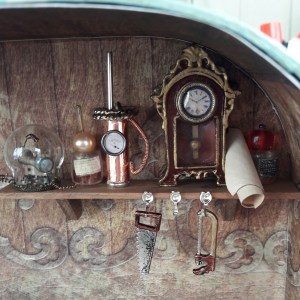 George Entwhistle, a patents clerk by day, had always enjoyed tinkering. The trouble was, tinkering could be a somewhat noisy activity. Living as he did in a terraced property, he had to contend with frequent complaints from neighbours and visits from members of the constabulary.
 Imagine George’s surprise and delight as he discovered a further door at the base, which opened quite easily, revealing a large cellar!
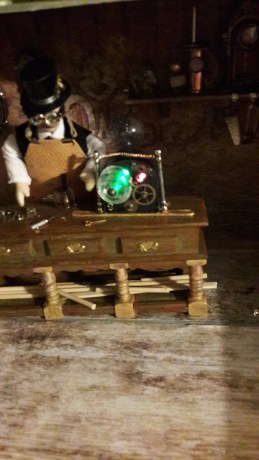 From that day onward, George worked to transform the cellar into a tinker’s workshop. He extended the heating pipes downwards to power a boiler, which not only heated the workshop, but allowed him to brew a much-needed cup of tea from time to time. He constructed a doorbell with a wire connecting it to the front of his house, so that callers could be heard. He made himself a shelf and workbench and even installed a clock and mirror. The result was a commodious and most agreeable work space. George was a happy man.
 As you can see, his contraption is well underway, and he’s able to fire it up for short periods.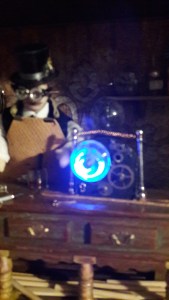
 I’d more or less given up, when I opened a draw and found some of these little creatures, bought in last year’s January sales, peering hopefully up at me.
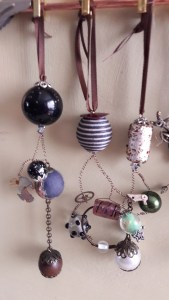 Idly I began twisting wire around needles to form coils and threading them with whatever came to hand – vintage beads from an old necklace, cog wheels and watch parts, bells, charms and even miniature teapots.
  The copper coils were bent and twisted at crazy angles and the weird, dangling objects that emerged were hung from lengths of ribbon.
 So I was staring at this gorgeous picture on Instagram – yes, this one here – and thinking how much I’d like to create something like it. Now I don’t have a soldering iron or any other metal-working skills or equipment. My woodworking ability stops at cutting up coffee stirrers and lolly sticks with a junior hacksaw. In fact, I’m strictly a glue-and-cardboard person if I need to make anything rigid. It didn’t look particularly hopeful.
 First there was much measuring, pattern cutting and trial and error with some nice brown card I had lying about. Next each piece was lined with card-backed fabric in a subdued floral pattern and the centre part of the body was glued in place. It looked roughly the right shape.
 It was at around this point that the vehicle’s name came to me. In Shakespeare’s A Winter’s Tale, there’s a character called Autolycus. He describes himself as ‘A snapper-up of unconsidered trifles’ and that is exactly what this vehicle was becoming. A spring from a ballpoint pen, the stick from a cotton bud, several small rubber washers, along with beads, chains, charms and jump rings from my junk jewellery collection all went into it. So The Autolycus it would be.
 Obviously it lacks the beautiful clean lines of the vehicle that inspired it, but I’m not unhappy with the overall result and I’m sure the ladies and gents at Steampunk-Shrunk will be rather interested in this strange vehicle, despite the fact that it’s the steampunk equivalent of a smart car and only the skinniest and most agile contortionist would be able to get inside and steer the thing.
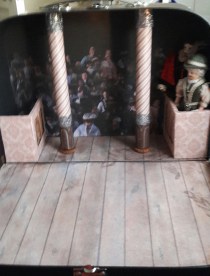

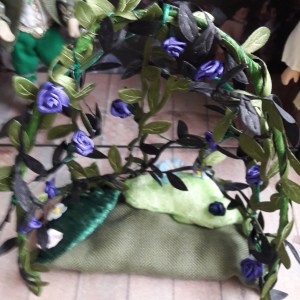


 Freddy Huntington-Groff casually selected one of the silver-handled screwdrivers from his breast pocket and lifted the bonnet.
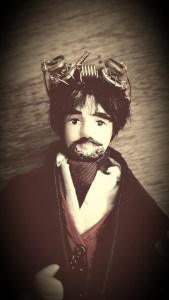 Yes, tensions were building. Tobias had always viewed the car as his ‘Angel’ but now, with Freddy’s arrival on the scene, he appeared to have a rival.
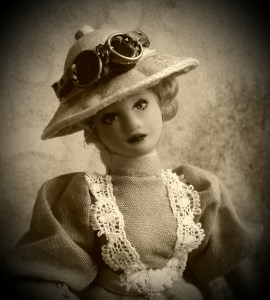 Both men turned to look at her. It was difficult to look anywhere else when Josephine was in the vicinity.
 Tobias and several other members of the Steampunk – Shrunk community will be joining the others there within the next few weeks, while Freddy, Josephine and The Angel will remain with those of us who visit craft fairs, steampunk events and miniatures sales.
 This is how Tobias looked when he first arrived at Shrunk Towers. I think his name was probably Paul or Richard.
 After a bit of Steampunk-Shrunk magic, he ended up looking like this – fine leather coat, hand-stitched black wool trousers, satin waistcoat, cravat and a serious facial makeover.
 I’d barely started browsing, when I saw the car in a shop window.
 Every spare minute was given over to The Angel during the next three days. Shiny gold and silver nail varnish covered the blotchy detail paintwork. Gold cord trim made the upholstery look neater.
 Tobias declared himself satisfied with the result and, pulling down his goggles, climbed back into the driving seat for a photo-shoot.
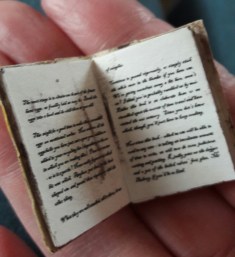 Should the apostrophe come before or after the s there? We are not entirely sure whether we speak here of one or multiple philosophers. Certainly it may be the case that the esteemed authors of this tome were able to conjure this miraculous substance, but we are not telling. How stupid do you think we are? History will be able to judge whether or not we have been successful in our attempt to discover the source of eternal youth. Should this volume be published posthumously, or read in a time when one or both is no longer incarnate, then the reader may judge for himself our lack of success in this area.
 Now since this book – which no one will be able to read in any case – is taking an inordinate amount of time to write, we will now do some judicious cutting and pasting. Kindly pass me the dagger and a pot of the boiled calves’ foot glue, Mr Aubrey, if you’d be so kind.
 We hope you find the experience as edifying and instructive as you wish it to be. There are a few side effects, so if you should experience nausea, dizziness, ringing in the ears, or any other appendage, don’t attempt litigation. We – remember – are highly experienced time travellers and you will never catch up with us.
 Nervous, us? Do we look nervous? Well maybe Penelope, slightly – but the rest of us will take good care of her.
 When we finally arrive at the destination – a village called Haddenham in a place called Buckinghamshire – she’s promised us that we will meet other people of a similar size to ourselves.
 Steampunk - Shrunk!