
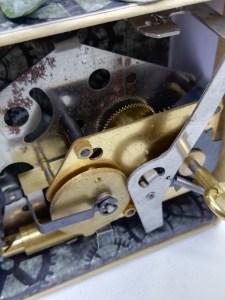
 I’ve written before about the day I answered a strange advert on a local noticeboard, offering ‘a flock of clockwork birds’. It was several years ago but I clearly recall the vendor reaching into a box of mouse-shredded newspapers and pulling out one of the little mechanisms for my inspection. It seemed to be composed of brass, steel and rust, in more or less equal quantities, with a plastic section to one side which housed a rubber diaphragm. With the sort of smile a favourite uncle gives at children’s parties before performing magic tricks, he took a brass key from his pocket, began to wind the motor and with a loud snap, the spring broke.
“Oh dear,” he said, carelessly tossing it back into the box and removing another, “They have been kicking around an attic for about 40 years, Not surprising, really. Let’s try this one.”
The next purred into life perfectly. Metal arms moved to and fro, a blue steel lever pumped the rubber bellows and a tiny Swanee whistle twittered its modulated tune. The whole thing, he explained, was controlled by a complex steel cam just visible amongst the whirring brass cogs and gears.
I was smitten.
“And how many are there?” I asked eagerly.
“God! No idea! Hundreds – at least,” he grinned. “Do you have a van? No? I’ll drop them round to you tonight, then.”
I’d been expecting a dozen, or maybe twenty, for the money he was asking. As my hallway filled up with an endless stack of mouldering cardboard boxes and a musty smell I wondered whether any of the mice whose handiwork I’d witnessed earlier remained. The boxes were stacked in the shed.
In the days that followed, I gingerly investigated. Countless clockwork motors ranging from pristine to utterly wrecked, a huge box of small plastic birds and yellowing waxed envelopes with the precious brass keys and parts to join the birds to the mechanisms. There was also a sheet of rodent-nibbled instructions for putting them together and a hobbies annual from the early 1960s where I found the sets advertised for 9 shillings and sixpence each, for fixing into novelty cigarette boxes. It seemed I had inadvertently bought up the entire remaining stock.
I grew up in a different age. I’m female. When I asked (every year) for a Meccano set for Christmas, my parents smiled and gave me a dolls’ pram or toy iron and ironing board. When I put down woodwork and metalwork as my preferred technology options at school, I was allocated to domestic science (aka cooking and housework) and needlework classes.

Can I blame this background for my almost total ineptitude with anything mechanical? Maybe not, but still it took me many, many weeks of fruitless and frustrating experimenting to begin producing chirping and twirling birds, perched on little boxes of clockwork wonders.
I sold dozens of them, and dozens more of the motor sets (with shredded newspaper and mouse droppings removed). However the number of broken mechanisms gradually began to outnumber the remaining working sets and I started to wonder how they could be used. In most cases the motors worked fine, but the rubber diaphragms that created the bellows had perished, which meant they were silent. Putting my woefully limited technological skills to work, I examined them. Two metal bars moved irregularly backwards and forwards. An offset lump on a wheel turned round and round quite fast when detached from the broken bellows. Three moving parts, then. What could I do with them?
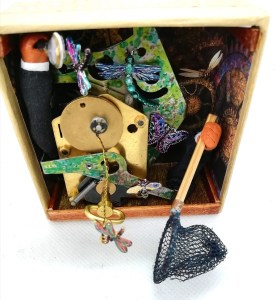
Idea 1 came from a miniature butterfly net I’d bought in a job lot of dolls’ house furniture. Two dismembered arms move up and down – one waving the net, the other grasping a magnifying glass while a small metal bug whizzes around and others perch nearby. I called it The Clockwork Entomologist and am now making some more of them. They’re my sort of crazy.
 Idea 2 is a silent version of the bird model, but with a seahorse emerging from glittery weeds to search left and right. It went too fast and smoothly at first, so I added some shell charms to the whizzing wheel to slow it down a bit.
 Idea 3 is probably the most ambitious – an evil octopus kicks a small hapless jellyfish, who turns the machine that works the robot angler fish above the undersea lair. This creature hunts for tiny fishes in the weeds to provide supper for the octopus. That one is off the wall, even for me!
 Finally (for now) there is another angler fish – simpler but more deadly with gaping mouth, huge teeth a battery-operated light-up lure, chasing her prey as it swiftly darts about and changes direction.
I can imagine readers of this post shaking their heads sadly at my lack of skill in fully utilising the intricacies of these amazing little motors. In my defense, I can only say that they all do what I had intended them to do, they are all constructed almost exclusively from upcycled junk and cast-offs and I had tremendous fun making them.
A few of them are for sale in my Etsy shop. More will be available when I replenish supplies in the New Year. They’re incredibly fiddly to make for one this clueless!


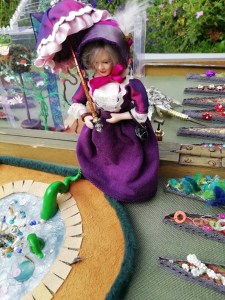 Her project for the last few weeks has been the long-forgotten Backgammon Garden. It was almost completed several years ago, but a leaning orangery and broken lawnmower meant that it lay forgotten while other tasks took precedence. Finally, she opened the vintage box once more and shook her head sadly.
 “I think I can fix Draig, Penelope,” she told me. “The blades just need to be remounted.” (Draig, for those who may be wondering, is the metal dragon lawnmower who patrols the garden, keeping it neat.) “The pond will be fine with a bit of adjustment to the fountain. The standpipe needs a touch of distressing to get the patina right, but what can we do with that orangery?”
 A selection of bamboo skewers, polystyrene balls, greenery intended for model railways, mock oranges and epoxy putty was assembled, together with various paints and glues, and at last the clipped orange trees were ready. Slightly unconventional, perhaps, but maybe it isn’t the only outbuilding that is held up by its trees.

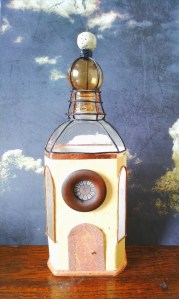
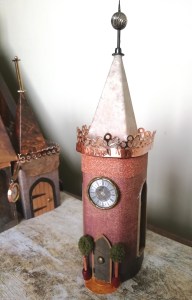


 It all started with tea. Hardly surprising – our little hive of fairly pointless but hugely enjoyable industry runs largely on tea most of the time. Not, I hasten to add, the sweetened, milk-infested mud-brown builders’ variety. We are partial to fascinating infusions – green, white, herbal – with
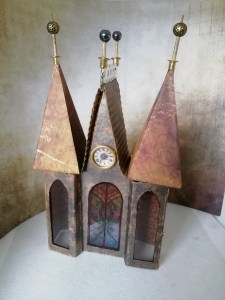
 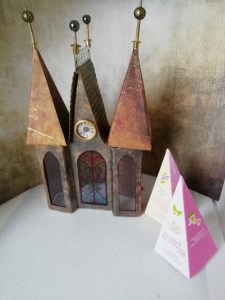 More tea was imbibed, more empty boxes found, and interesting paint or paper applied to every surface. That clear plastic box in which the tea bags had arrived was pressed into service to make arched windows. Curtain rings, cocktail sticks, drinking straws and various beads were gathered. The extensive stash of adhesive tapes – metallic, decorative, double-sided – was raided. Gradually a rather wonky, rust-toned, multi-towered building emerged.
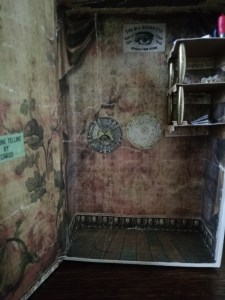 “Charles,” I called, “Could you give me a hand making a set of shelves for a little room I’m putting together? A stack of about three, to hang on the wall? A nice grungy but feminine paint or paper finish, please.”
 The next day all was ready for Sabrina to move in. She was delighted with the room and spent some time putting up posters and charts, then began stacking her shelves and arranging the furniture.
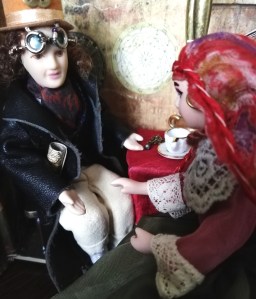 Charles nodded meekly and sat down. He answered Psychic Sabrina’s questions – his name, his circumstances – without once taking his eyes from her face. She smiled and nodded, studying him just as intently.

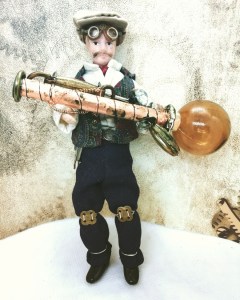

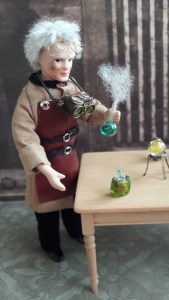
 Just imagine our amazement when the infamous Dr Oskar Kopp and his ‘enhanced’ assistant Bjørn arrived. They had left us several years ago to accompany a reknowned storyteller and share their tales with her audiences. Now, it seems, the good lady is moving to another continent and asked whether she could return these gentlemen and their laboratory to us.
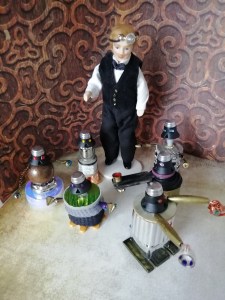 “But what about these small, er, devices of yours?” Mrs S enquired.
 The very next day, Mr Coggleford the furniture restorer and young Jasper, his son and apprentice, told us that they intended to follow in Gus’s footsteps and would be taking one of the time machines as well as one of their finest cabinets with them.
 Far off, in a deep meandering gorge in the Archipelagonian mountains, are the caves where the Time Dragons nest.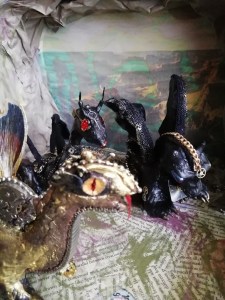


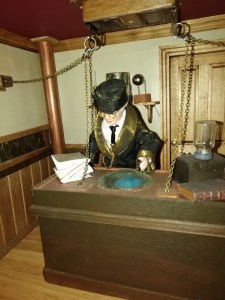
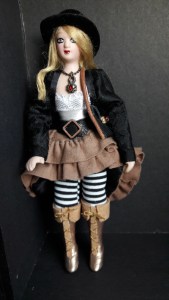
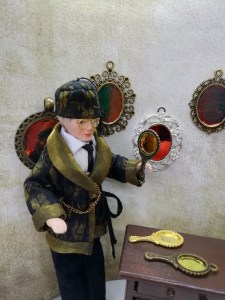 Here is Ruby, who moved away long ago. For her the Professor has chosen one of these delicate holographic scrying mirrors.
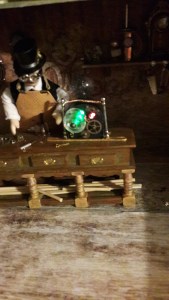

 Young Henry, here, travelled to the East Coast of the United States some time ago and promptly changed his name.
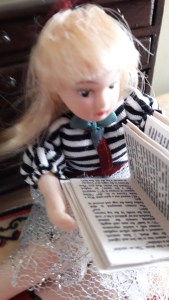 Little Molly has, he knows, gone to an excellent new home in North Wales. However he has decided to send her some more books, as she can never have enough.
 Steampunk - Shrunk!