
Here it is, then: the competition to finish off the Vital Chapter saga.
It will be small. I only do small.
 The prize will be small – barely an inch wide or long. The number of entries will be small, as my ability to publicise on social media is sadly lacking and Steampunk-Shrunk is rather, er, niche, to say the least.
However it will give you the chance to win a totally unique miniature book, which you will have helped to write, and it will be fun, for all of us.
 Briefly, then: I made a 1:12 scale room – a library – in a little case. It was called The Case of the Missing Chapter and in the room was a very small book, containing the story of one Algernon Cholmondeley, but with the vital chapter explaining the remarkable change in this gentleman’s fortunes carefully removed by a person or persons unknown.
Your task, dear reader, is to write that missing chapter! Algy’s story, along with photos of the dolls, gadgets and settings I ended up making along the way, has been serialised on this website over the past few weeks. It’s reproduced in its entirety below, to save you the trouble of hunting through the archives.
What to do, terms and conditions and all that jazz:
- Write your own version of Chapter 4 (max 1000 words) and submit it either in the ‘Leave a reply’ box at the bottom of the page or via the contact form just above it.
- It would also be very helpful if you would tag, share or otherwise notify one or two like-minded friends of the competition and encourage them to visit this site. (I’m assured this is how savvy entrepreneurs drum up business.)
- By entering, you agree that if you win or are a close runner-up, your name (real or pseudonym, as you prefer) and your chapter can be printed on this website, which is available for public viewing.
- No copies of the winning chapter – other than the single prize edition – will be made or offered for sale and the copyright remains the author’s own.
- Information you provide (name, email address etc.) will only be used for the purposes of this competition and will not be stored or passed on to anyone else.
- One winner will receive a one-off printed copy of the completed book including their chapter at 1:12 scale (readable with a powerful magnifying glass). No cash alternative, as this unique item will be, obviously, priceless.
- Oh yes, closing date – almost forgot! All entries to be received by Monday 21st August 2017. Winner will be notified by 2nd September.
- Phew! I think that’s it. I’m new to this sort of thing.
Should I receive any entries (told you it was small!) Olivia Libris – the entirely fictional author of the book – will select the chapter that seems to her to fit best with the style, content and general silliness of the original and it will be printed for all to enjoy in a further post.
Here, then, is the story as it currently stands:
The Vital Chapter by O Libris
Chapter 1
Since the beginning of the year, Algernon Cholmondeley had been feeling somewhat out of sorts.
It began when his prize peacock simply keeled over and died in the very centre of the drive on New Year’s Day. By unfortunate circumstances, many guests were due at The Grey House for a party on that very occasion. Carriages and steam-powered automobiles had been arriving for some time. Each driver had been forced to swerve to avoid the bird, which was lurching around and staggering about in the most ungainly manner. The screeching of brakes and the parping of horns and claxons provided an unwelcome accompaniment to the gentle welcome offered by Algernon and his delightful wife Josephine.
At four minutes past five precisely, the peacock stood still, made a feeble attempt to confound death by opening its once-splendid tail, fell to the ground and flopped untidily on the lawn which lay at the centre of the gravelled driveway.
“Did you know there’s a dead peacock in the middle of the drive, Algernon, old chap?” asked one guest after another as they arrived at the front door.
No seasonal felicitations. No extended hand offering a friendly shake. Not even enquiries into the health of the host and hostess.
Some delivered the line with concern, others with wry amusement, a few with puzzlement and still more with unconcealed hilarity.
Nor did it stop there. Once inside the ballroom, the guests continued to discuss the deceased creature with gusto. Ladies were heard to express wistful desires for a feather or two to adorn their hats, since the unfortunate possessor of these trimmings would no longer be in any need of them.
“A few of those exquisite breast feathers would set off my new gown quite wonderfully,” one lady was heard to say. “Just the shade of turquoise I have been searching for. I wonder whether it would be indelicate to ask.”
The gentlemen seemed more interested in how the bird would taste roasted with an apple and cranberry stuffing, but felt it unlikely that the cook would have time to prepare it for that evening’s banquet.
“Just drawing and plucking a bird that size would take a number of hours, I would imagine,” sighed a gentleman who looked to have consumed more than enough delicacies during the festive season, given the strain placed upon his waistcoat buttons.
Next the conversation turned to possible reasons for the creature’s demise. The early arrivals were able to give those who had appeared more recently a fascinating account of the peacock’s final hours. With many sound effects and gesticulations, they re-enacted the problems they had encountered during their attempts to negotiate the drive and park safely.
“Staggering about like a drunk, it was!” announced Charlie Stammers-Bottington. “Quite thought I was going to hit the beast. First it veered one way, then the other, with never a glance towards my vehicle. And you fellows must admit, it’s not an easy thing to miss.”
Others agreed readily that Charlie’s traction engine was indeed a very powerful presence on any driveway, and would be hard to ignore.
A man in a brown suit, whose brother-in-law was a veterinarian, said he’d heard the aforesaid brother-in-law speak of an outbreak of avian influenza, which had swept across the country from Prussia. There was a general consensus that this was the most probable cause of death.
“It’ll probably spread to any other birds on the estate,” someone warned.
“Do you keep any other birds, Algy?” Henry Stuffingham called across the room. “Probably best to have them shot and burn the carcasses. Can’t be too careful with something like this, y’know.”
Algernon poured himself another glass of brandy and shook his head. The conversation showed no sign of abating. His attempts to instigate some lively parlour games fell – if not on deaf ears – on ears that were deaf to any subject beyond the accursed peacock.
Even at dinner, the subject refused – unlike its physical counterpart – to die.
“That roast bird’s a good size,” one wag remarked. “Not a peacock by any chance?”
The raucous laughter which followed this rather weak joke was the final straw for poor Algernon.
He rose unsteadily to his feet and roared, “If anyone else raises the subject of that confounded bird this evening, they may consider themselves unwelcome in this house, both now and in the future! Kindly do not allude to it in any way whassover – what sever – oh! Just drat the thing, that’s all!”
He sank back into his chair, covered his face with his hand and began to weep.
There was the most awkward silence, which seemed to last for an eternity. It was as if, deprived of their sole topic of conversation, the guests had been rendered quite mute.
Dinner was finished silently, apart from the clanking of silver on fine bone china, which sound now seemed extraordinarily loud.
As soon as was deemed prudent, first one couple then another made lame and hurried excuses for their early departure and left. There was a veritable stampede for the door, so much so, that quite a queue of vehicles formed, waiting to leave. All eyes within them stared balefully at the corpse of the peacock, but no lips moved.
It was unlikely that any of these people – his once dearest friends and acquaintances – would ever return, Algernon mused, glumly. His name would, for all time, be inexorably linked to this bird.
“Oh Algernon?” people would say, “the chap with the dead peacock?”
Sniggers would follow. He would be a laughing stock from that day forth.
Chapter 2
This unfortunate circumstance was, as has previously been intimated, only the beginning of a set of events which seemed to go from bad to worse.
Algernon’s mother-in-law came down with a most tiresome condition, which seemed to involve a great deal of coughing – particularly during the small hours and after lunch – and it was decided that she would have to stay at the Grey House until she was well enough to return to London.
This lady had never been particularly well-disposed towards her son-in-law. Now that her temper was rendered somewhat shorter, presumably by her malady and lack of sleep, she became quite vociferous in her criticism and complaints about him.
“Why ever didn’t you marry that boy from the East India Company, Josephine?” she would demand of her daughter. “Much better prospects, I would have said.” or “Oh my dear, are you still wearing that style? Surely your husband could afford to buy you something a little less dated?”
Josephine busied herself with bathing her mother’s forehead and preparing herbal concoctions to ease her cough, and looked endlessly miserable.
Algernon couldn’t decide whether this was because she secretly agreed with her mother and was now regretting her marriage or because her mother’s criticisms of her beloved husband distressed her severely, although she was unwilling to contradict her ailing parent.
He considered asking his wife which of these was the case, in order to calm his tormented mind, but – if truth be told – his mood was now so low that he strongly suspected that it was the former, and could not bring himself to have his worst fears confirmed.
In February – in fact on February 14th – the parlour maid and Algy’s favourite groom eloped together. Algernon was furious at the inconvenience caused by this selfish action. Why should servants run off to enjoy a future together without a second thought for those they left behind? Now he would have to find replacements for them and the new staff would need to be trained in how matters were conducted at the Grey House.
None of the aforementioned events could be called catastrophic, but together they created a most unhappy state of affairs for Algernon and he became extremely downhearted. He took to hiding away in his study for long hours and even chose to have his meals there on frequent occasions.
“Algy, dear, please don’t punish me so!” entreated Josephine. “I know mother can be rather tiresome and I understand that you are not in the best of humours, but I do miss your company at dinner.”
Alas, Algernon was deaf to the pleadings of his beautiful wife. He simply became more introspective and silent.
Chapter 3
 On a bright morning in early spring, Harvey’s hot air balloon crash landed in the vegetable patch. He’d been aiming for the meadow, but a sudden gust of wind in the final moments of descent blew him off course.
Harvey was Algernon’s younger brother. Josephine had summoned him back from the Congo as her alarm at Algernon’s state of mind continued to grow. If anyone could cheer her husband, it would be Harvey.
“What in the name of thunder is going on?” screamed Algernon, racing out of the French doors to inspect the damage to his property.
“Who the deuce has landed that damned contraption on my land?”
He grabbed his steam-powered plasma gun and was about to fire a volley of shots into the basket when he heard a jaunty “Hulloo” in the unmistakable tones of his brother.
That gentleman emerged rather unsteadily from the basket, pulled up his goggles to reveal a tanned, soot-smeared face and raced over to embrace Algernon, who had – fortunately – dropped his weapon and was standing and blinking in disbelief.
“My dearest boy!” Harvey exclaimed, grasping his brother’s hand in both of his own and pumping it up and down as if trying to start an engine.
“But Harvey…” stuttered Algernon. “After all these years! How? Why…?”
At this moment, Josephine rushed up and warmly embraced her brother-in-law.
“Dearest Harvey, how wonderful to see you again. Do come inside and have a cup of tea. We’d just love to hear about all your adventures, wouldn’t we, Algy?”
“Um, indeed,” her husband responded weakly, absent-mindedly removing a broad bean tendril from his brother’s greatcoat. “Yes, of course. Do come inside.”
Half an hour later, they were sitting, sipping tea, around a blazing fire in the drawing room.
Harvey had brought with him a battered map of the diamond mine he had bought in Africa.
“Amazing potential!” he was exclaiming. “Stunning gems in there. Worth a king’s ransom! By Jove, Algy, you should come out there with me. We could run the place together. Lord, you should see the engine I’ve got set up for the extraction process. Such a beauty! It simply can’t fail. We’ll make millions!”
Josephine glanced at Algernon. This was not quite the way she had anticipated that the discussion would go.
Algernon sat listening passively as his brother extolled the virtues of life in Africa. It was difficult to read his thoughts from his expression.
Finally, he spoke.
“Oh such adventures are just fine for a young fellow like yourself, my dear Harvey. Nothing to hold you here, no family or obligations to consider. I’m delighted for you, old boy. Wouldn’t do for me, though. There’s this old pile to keep up, the staff to consider, all the horses… and I couldn’t ask Josephine to up sticks and adjust to such a difficult climate.”
“Pah! Loads of lovely ladies over there!” returned Harvey. “They have a whale of a time. As for this old place – sell it up and start afresh. You’ll make your fortune. Nothing to lose.”
“Well I’ll give it some thought,” Algernon replied, and promptly left the room and headed back to his study.
“Glad you sent for me, old girl,” Harvey told Josephine. “I see what you mean. He does seem rather out of sorts.”
“Oh Harvey, I’m so worried about him!” Josephine cried. “It is so good of you to have come all this way. I’m sure it will cheer him up to have you around. Perhaps you could go riding with him tomorrow, if you’re sufficiently rested. He’d very much enjoy that.”
“Riding?” asked Harvey. “You mean horses? Oh no. What Algy needs is some adventure. Give me a day or two to get the balloon sorted out and I’ll take him for a trip in that. That’ll do him the world of good. You see if it doesn’t.”
Chapter 4: MISSING
Chapter 5
 Algernon lifted his telescope to his eye and scanned the horizon. Just one small smudge of grey over Middlesex. It was high in the sky. A less practised eye would have missed it altogether, or mistaken it for a wisp of cloud.
“Pirates at four o’clock,” he called. “Prime the machine.”
Sure enough, as they moved closer, the unmistakable shape of a steam galleon became clear – smoke belching from her filthy funnels.
“Machine’s primed and ready, Sah!” barked a voice from below decks.
“Good work, Mister Capon. Keep tracking them. I’m going to turn her around so they can’t see our profile. Wait for the order to fire.”
“Aye, Sah!” came the same clipped voice.
Like the rest of the crew, Edwin Capon was proud to serve under Admiral Algernon Cholmondeley. Their airship was the envy of the fleet and the scourge of the pirates who had, for far too long, held the airways to ransom.
Too late, the commander of the pirate vessel – one Sydney Strangefellow – saw what lay ahead.
“Put her about, boys!” he croaked, his fear only too obvious to his crew.
“A trap! That’s the Algernaut!”
“God save us!” screamed one of the men – an optimistic fellow with a high regard for the generosity of his Maker, since he and his shipmates had spent their lives ruthlessly terrorising the high skies.
Panic broke out on the vessel and men ran helplessly hither and thither. They knew – every black-hearted villain of them – that nothing, let alone their old rust-bucket of a ship, could withstand the weapon now fixed of upon them.
“And … FIRE!” shouted Algernon.
There was a flash of turquoise blue as the plasma gun loosed a volley of shots towards the pirate vessel.
The end was quick. An explosion of blinding white light and then – nothing. Not so much as a nut or a bolt remained of the incinerated galleon.
A cheer went up from the crew of the Algernaut and a door opened from a cabin below decks.
“Why the cheers?” asked a soft, sweet voice, as Lady Josephine emerged. “Have you clever boys destroyed another pirate vessel?”
“We have indeed, your ladyship,” smiled the midshipman, bowing his head deferentially. The Admiral spotted it miles off. They didn’t stand a chance.”
“Well jolly good show,” smiled the lady. “I’ll go straight away and prepare some tea for all hands. And I’m sure I can find some particularly delicious cake as well. You boys certainly deserve it!”
“You spoil us, my dear,” said her husband, who had come below to share the good news with her.
“Not at all,” laughed Josephine. “Thanks to your splendid invention and your excellent crew, the skies above London have never been so safe.”
“Three cheers for the Hadmiral and ’er ladyship!” barked Edwin Capon, and the crew’s enthusiastic cries could be heard far below, in the city that owed its safety to Algernon Cholmondeley.
Do please enter and encourage your friends to do likewise. You can use the ‘Leave a reply’ box under this post, or here’s a contact form, if you’d like to keep your entry just between ourselves…


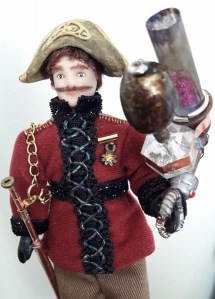 Algernon lifted his telescope to his eye and scanned the horizon. Just one small smudge of grey over Middlesex. It was high in the sky. A less practised eye would have missed it altogether, or mistaken it for a wisp of cloud.
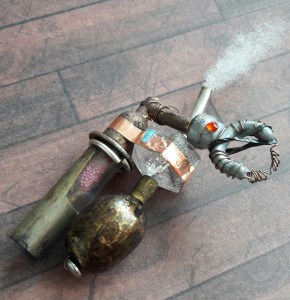 Panic broke out on the vessel and men ran helplessly hither and thither. They knew – every black-hearted villain of them – that nothing, let alone their old rust-bucket of a ship, could withstand the weapon now fixed of upon them.
 “Well jolly good show,” smiled the lady. “I’ll go straight away and prepare some tea for all hands. And I’m sure I can find some particularly delicious cake as well. You boys certainly deserve it!”
 Josephine busied herself with bathing her mother’s forehead and preparing herbal concoctions to ease her cough, and looked endlessly miserable.
 If anything, these words made me more apprehensive than I had previously been. As I alighted from the contraption and the smoke from its boiler began to clear, I saw a figure who could only be Lord Horatio standing beside a rusting collection of gears and machine parts. Despite my determination to maintain a calm demeanour, I have to admit that I gasped – or possibly squealed slightly.
 His words were friendly enough, though it was difficult to read his expression, since the vast majority of his face was covered, either by his enormous moustache or by the huge monocle he wore.
 “What do you think of that?” he demanded, his voice bursting with pride as he threw open the door.
 Blades are razor sharp, though. My gardeners tell me the cut he gives is second to none.”
 It’s a tiny room – just 8 inches wide by 6 inches high, and a mere 3 inches deep when the case is closed. As it’s at 1:12 scale, that equates to the same number of feet in our measurements.
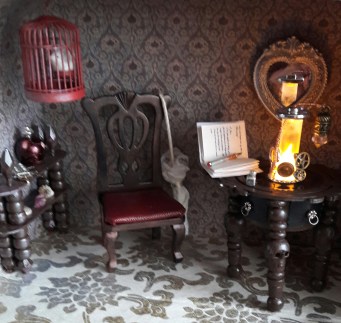 She has persuaded one of the gardeners to tutor her in the rudiments of welding and metalwork, and by patiently dismantling clockwork machinery, she is teaching herself to build simple gadgets. The lamp was one of her first. It’s simple, but effective, switching on when the attached clock shows that dusk has fallen.
 Hello. It is me, Bjørn again. I was telling you in
 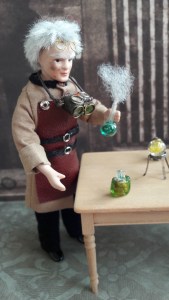 “If you ver villing, though, zis could be altered. Wat if I ver to offer you a new heart and a new brain? You have seen ze marvels I can do. It would be ze most glorious experiment, in ze name of Science! If you ver villing, you could become a showcase of mein art! Your mechanised brain and heart on display for all to see ze vunders of ze clockverk body. You could achieve anything once zese adjustments had been made. You’d be as great as me. Maybe greater…”
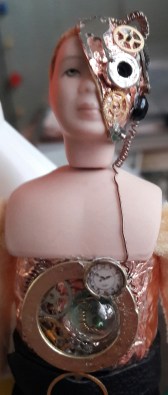 Eagerly I agreed. My weak heart, which had almost killed me once, would be replaced with a dependable clockwork mechanism, encased in a glass dome, so that all could wonder at its strength, and at my master’s skill. I would be a walking advertisement for his abilities. He explained less about the alterations to my brain, but I was led to understand that my ability to learn, to reason and to imagine would be considerably enhanced.
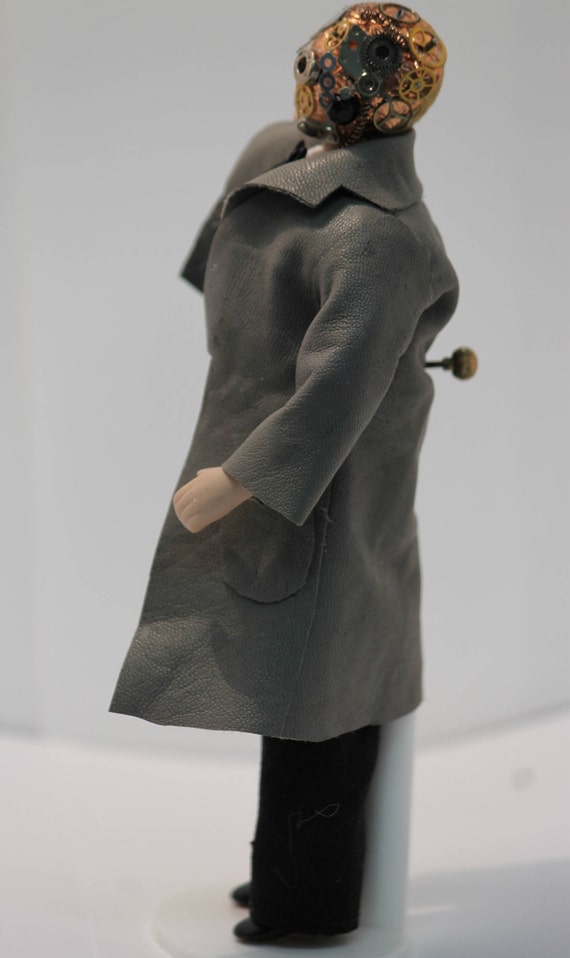 Certainly now my mind and heart are stronger, keener than they were. I can work harder, faster, better and I hold information and make deductions at lightning speed. All this, the Doctor expected. Perhaps he feared it slightly. Yet he found a way to maintain his dominance.
 “We almost sold the engine room,” announced the young man who runs one of the shops (the physical one) I supply, when I wandered in with some new stock last week.
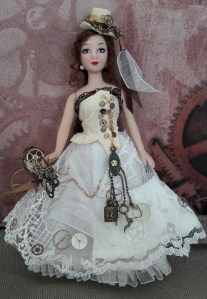 The responses were many and various! Many iconised likes, loves and wows. The comments ranged from the singularly unhelpful ‘Dress her in black!!’, through ‘What IS steampunk?’ to one person who solicitously explained the difference between cogs and fly wheels as she thought I must be confused. As I had hoped and expected, though, many of the kind and lovely people took time to suggest extras and modifications that would help me to fulfil the brief.
 The veil – their collected wisdom told me – had to go. The headdress had to include (oh shudder and groan at the dreary cliché!) a top hat, and possibly goggles. The bouquet needed to be bigger and bolder, the bodice more decorated and – at her waist – either a pouch or (I loved this idea) a chatelaine.
 So, having added several necklace chains worth of metalwork, a (heavily disguised) kid leather hat and gone along with the other ideas – except the dratted goggles; I have my pride! – I reposted my altered little lady.


 Well if that person is reading this, they might like to take a trip over to the
 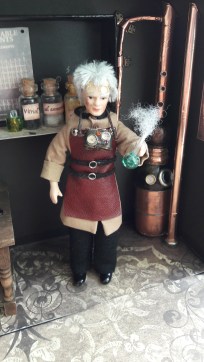 Vell I ask you, if you were to come into possession of an ancient grimoire vhich contained (along wiz ze normal recipes for creating ze philosophers’ stone und cures for varts) a spell entitled ‘How to Traverse Time’, vouldn’t you be a little intrigued? Vouldn’t you give up a successful career to explore ze secrets it offers?
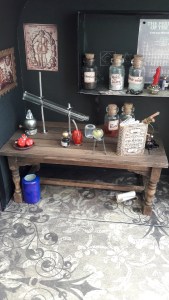 I had a huge laboratory, back in zose days. Mechanical construction vas my bread-und-butter. Alvays zer ver young men vanting automatons, adjustments to zer contraptions and votnots. Fraulein Vorzington, my young assistant, vas quite excellent at such sings. I left her to it. For me, reading ancient texts vas far more important. I had zis strong feeling zat vun day, I vould discover zat for vich I searched. Und here it is – ein dusty old volume, standing on my small table in my tiny, dark garret. Viz zis book, I vill conquer time itself!
 Then, of course, there is the doctor himself, with his plasma- and aether-sensitive binocular eyepiece, not to mention the infamous grimoire.
  The Case of the Alchemist’s Study will be on display on my stall at the Glastonbury Craft and Vintage Fair on Saturday 29th April, 2017. Other Steampunk – Shrunk figures, rooms and accessories are available at Rune Smith of Glastonbury, at 1 Monarch Way, off Glastonbury High Street and online at t
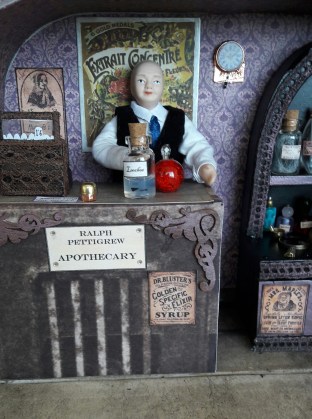 Good day, Sir and Madam.
 I have to say, I’m delighted with my small emporium. Don’t you just love the medicine cabinet? It was a generous gift from my dear friend Lady Grace and is ideally suited to my storage and display needs. Oh, pray do not touch the scales, Madam. They are most carefully balanced with a potion I was preparing for her ladyship when you arrived.
 I’m very pleased, too, with my counter, which I put together myself from some iron and wood my cousin Amelia had left over from building a steam engine.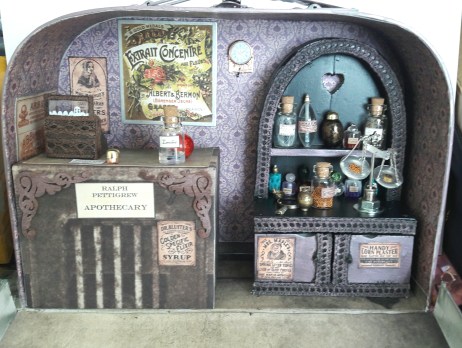
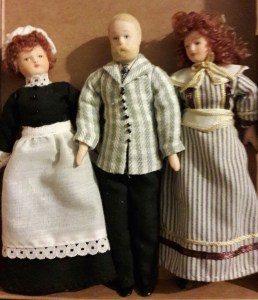 “Steampunked?” snorted the gentleman. “What kind of word is that? I don’t like the sound of it one little bit. Nor does my good lady wife or our maidservant, either. We are respectable people, I’ll have you know. ”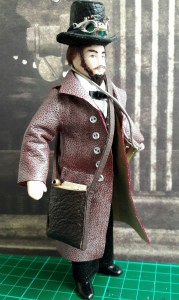
 Their gasps as they saw his glass buttoned cotton lawn shirt and brocade waistcoat suggested that I might be winning the argument. They noticed the gold watch chain and stared in amazement as I pulled his fob watch from the satin-trimmed waistcoat pocket. Next I took the brass binoculars from his neck for them to examine and emptied the contents of his inch long leather shoulder bag on to the table.
 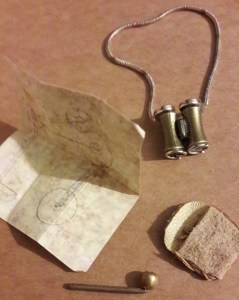 There was a folded, rather battered set of engineering plans, the pipe Isambard can never bear to be without and a tiny leather pouch containing tobacco (made from shredded leather).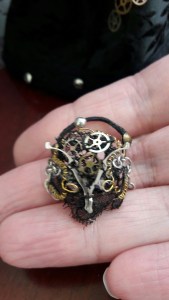
 Steampunk - Shrunk!